
Top Areas to Invest in Dubai (2026): A Risk-Mitigated, Data-Checked Guide
Last reviewed: 26 February 2026 (Dubai, UAE)
Publisher: IST Real Estate — RERA-registered brokerage (ORN 38858).
About IST
Quick Takeaways (Read this first)
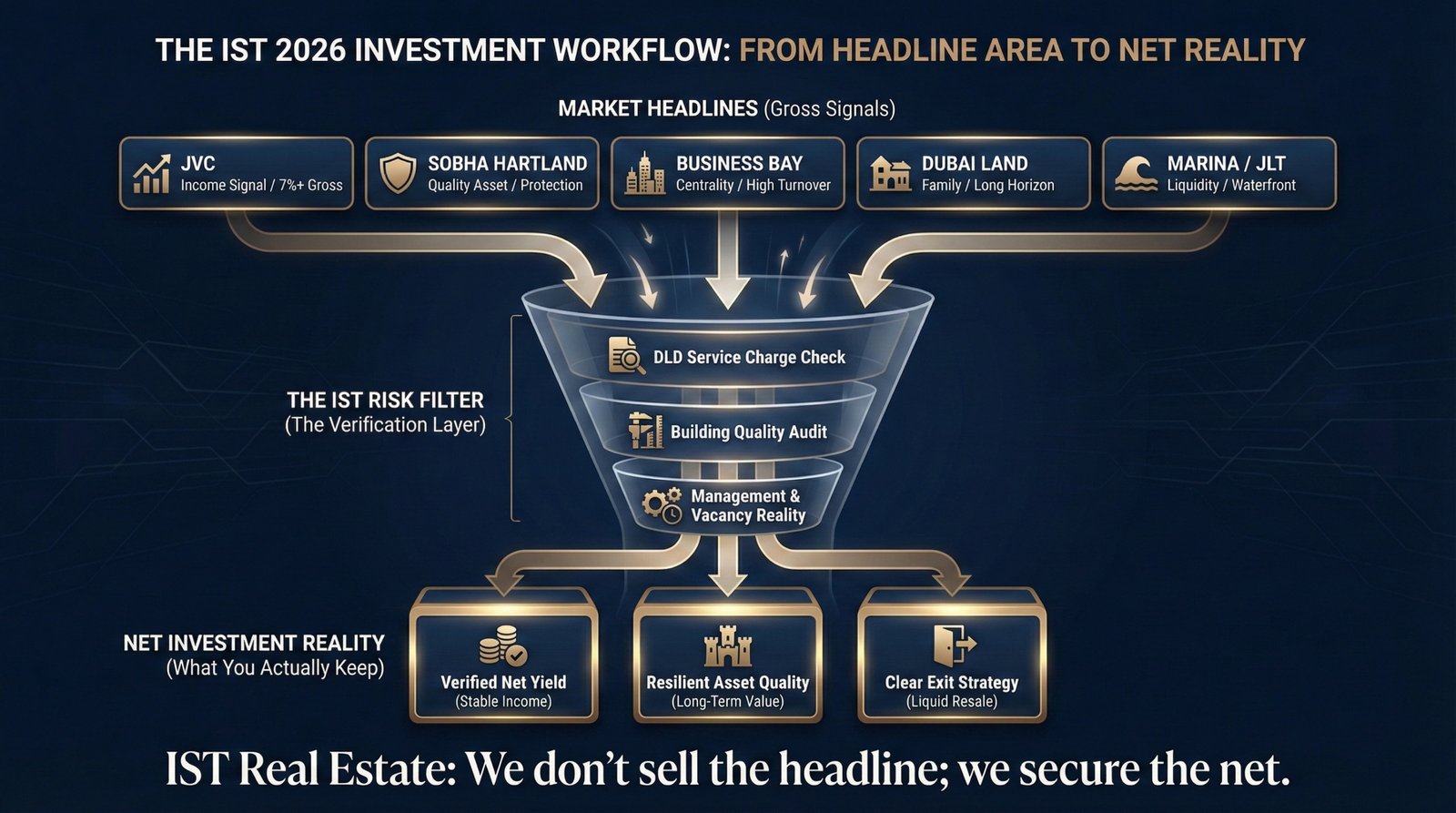
In 2026, smart capital deployment in Dubai is increasingly decided at the building level. Service charges, management quality, and unit liquidity can matter as much as the community name. Published ROI is a useful signal, but net outcomes change with costs and execution.
- Gross yield ≠ net yield. Net is what remains after service charges, vacancy, management, and maintenance reserves.
- Risk mitigation: verify service charges for the exact project/year using the official index:
DLD Service Charge Index. - 2026 data note (honesty rule): we use the latest full-year portal dataset (2025) as a baseline, then apply 2026 reality checks (selectivity, infrastructure timelines, and live inventory).
Request the IST Unit Pack for Your Shortlist
If you share your budget and strategy, we can help shortlist buildings and validate service-charge exposure and key fee items before you pay a booking or sign an SPA.
Fast Tracks (Jump to your strategy)
- Yield hunter: Jump to JVC
- Safe-haven / quality buyer: Jump to Sobha Hartland (MBR City)
- Resale liquidity: Jump to Dubai Marina / JLT
Comparison Table (clean + mobile-friendly)
This is a shortlist starter. Where we show numbers, we link to the original source. Then we add the IST lens: what to verify to avoid over-estimating net returns.
| Area | Best for | Key data (source-linked) | IST stance | What can break net returns |
|---|---|---|---|---|
| JVC | Income focus | ROI 7.42% • Avg. price/sq.ft 1,455 • Change +10.6% Source (Bayut 2025 Sales Report) |
Selective Buy | Charges + building dispersion |
| Sobha Hartland (MBR City) | Asset protection / quality | Example Hartland listing (IST) | Buy for quality | Carrying costs + exit discipline |
| Business Bay | Centrality + liquidity (tower-by-tower) | Market context (Gulf News) | Hold / Selective Buy | Tower fundamentals + charges |
| Dubai Land | Family formats / longer horizon | Browse Dubai Land listings (IST) | Buy if horizon fits | Handover timing + community fees |
| Dubai Marina / JLT | Secondary-market liquidity | Marina cited as preferred luxury sales destination (Bayut) | Hold for liquidity | Tower charges + strategy mismatch |
What we currently avoid in 2026 (the “negative space”)
We avoid avoidable risk. In 2026, we generally avoid deploying capital into assets where one or more of the following are true:
- Charges are high relative to achievable long-term rent (net yield risk).
- Recurring management/maintenance issues harm tenant retention (vacancy risk).
- Underwriting depends on aggressive short-term rental assumptions without operational readiness.
- Pricing is detached from comparable transactions and relies on narratives alone (timing risk).
Browse verified IST inventory (move from “area” to “building”)
- Explore our verified JVC listings
- Explore our verified Business Bay listings
- Explore our verified Dubai Land listings
- Explore waterfront inventory near Marina (JBR)
- Use Advanced Search (type “JLT”, “Dubai Marina”, “Sobha Verde”, “Hartland”)
1) Jumeirah Village Circle (JVC) — income-first, building-selective
IST take: If you’re searching “best ROI for studios in JVC in 2026”, the decision is rarely “JVC”. It’s the right building, the cost stack, and how quickly units lease in that micro-pocket.
Baseline data (portal dataset)
- Bayut’s 2025 report lists ROI 7.42%, avg price/sq.ft 1,455, change +10.6%.
Source (Bayut 2025 Sales Report)
Reality check (how asset managers think)
- Instead of chasing headline ROI, track the operating burden: service charges + a maintenance reserve, relative to achievable annual rent.
- Set your own underwriting threshold for that burden, and exclude buildings that repeatedly fail it. (This is a framework, not a universal number.)
- As noted above, verify charges via the official index and then sanity-check the building’s management quality and leasing friction.
2) Sobha Hartland (MBR City) — asset protection / quality bias
IST take: In premium communities, investors often win by owning quality stock with durable end-user demand—assuming the carrying-cost stack is verified and the exit plan is realistic.
Inventory proof (IST)
What to verify
- Carrying costs (charges and recurring cost stack) and how they impact net yield.
- Secondary-market liquidity for your layout (exit matters as much as entry).
- Don’t assume premium equals higher net yield—cost discipline decides outcomes.
3) Business Bay — centrality and liquidity, tower-by-tower
IST take: Business Bay is often a liquidity market, but tower selection and recurring costs determine whether capital is deployed efficiently.
2026 context
- Market summary and selectivity into 2026:
Source (Gulf News)
What to verify
- Tower fundamentals (maintenance, management, parking, amenities condition).
- Strategy mismatch risk (long-term vs furnished/short-term operations).
- As noted above, verify charges via the official index and model net conservatively.
4) Dubai Land — family formats and longer holding horizons
IST take: Dubai Land works when your horizon matches the product: family formats, community quality, and a realistic carrying-cost model.
Inventory proof (IST)
What to verify
- Community fees and recurring cost stack.
- Handover timing and micro-location demand (not the headline map pin).
- Exit plan (resale depth for your exact layout).
5) Dubai Marina / JLT — secondary-market liquidity strategy
IST take: Liquidity is not “easy money.” Marina/JLT decisions often come down to building economics—charges, management quality, and tenant profile.
Baseline data (portal dataset)
- Bayut’s 2025 report notes Dubai Marina retained its position as a preferred luxury apartment sales destination.
Source (Bayut 2025 Sales Report)
Inventory-aligned paths (IST)
- Explore waterfront inventory near Marina (JBR)
- Use Advanced Search (type “JLT”, “Dubai Marina”, “Sobha Verde”, “Sobha Hartland”)
What to verify
- Refurbishment cycles and management quality (older stock risk).
- Strategy mismatch: short-term operations have real costs and volatility.
- As noted above, verify charges via the official index and underwrite net conservatively.
Gross vs Net Yield (the sanity filter)
Bottom line: Gross yield is a headline. Net yield is what remains after charges, vacancy, management, maintenance reserve, and recurring costs. Verifying charges can change decisions.
Net yield ≈ rent − service charges − vacancy − management − maintenance reserve − other recurring costs.
Fees & Carrying Costs Checklist
- DLD references property registration service fees (including 4% of property value) in a published notice:
DLD notice - Verify service charges per project/year using the official index:
DLD Service Charge Index - Vacancy and leasing friction (model conservatively).
- Management and maintenance (especially for furnished/short-term strategies).
- Financing costs (if applicable).
FAQ
1) Why is this a “2026” guide if some sources are 2025?
Because 2025 is the latest full-year baseline from a major portal dataset. We use it as the starting point and then apply 2026 reality checks (selectivity, cost stacks, and live inventory). For context into 2026:
Gulf News
2) Where can I read the foreign-buyer safety steps (freehold, process, risk)?
Read IST’s guide:
Freehold Ownership in Dubai: A Comprehensive Guide for Foreign Investors
3) What should I do next if I have a budget and shortlist?
Shortlist buildings, validate charges and cost stack, then compare net outcomes and exit options. If you want help building the building-by-building shortlist, contact IST.
Request the IST Unit Pack Before You Commit Funds
Ask for the IST Unit Pack to validate service charges, key fee items, and building-level risks for your shortlisted options before signing or wiring funds.
Sources & Last Reviewed
Last reviewed: 26 February 2026
- IST About page (ORN 38858): https://istrealestate.ae/about/
- Bayut Sales Market Report 2025 (baseline dataset): https://www.bayut.com/mybayut/dubai-sales-market-report-2025/
- DLD registration fee notice (4% reference): https://dubailand.gov.ae/en/news-media/dld-calls-on-developers-to-pay-property-registration-fees-within-60-days/
- Gulf News market context into 2026: https://gulfnews.com/business/property/from-jvc-to-dubai-south-these-areas-saw-the-biggest-price-and-rent-gains-in-2025-1.500402070


Join The Discussion